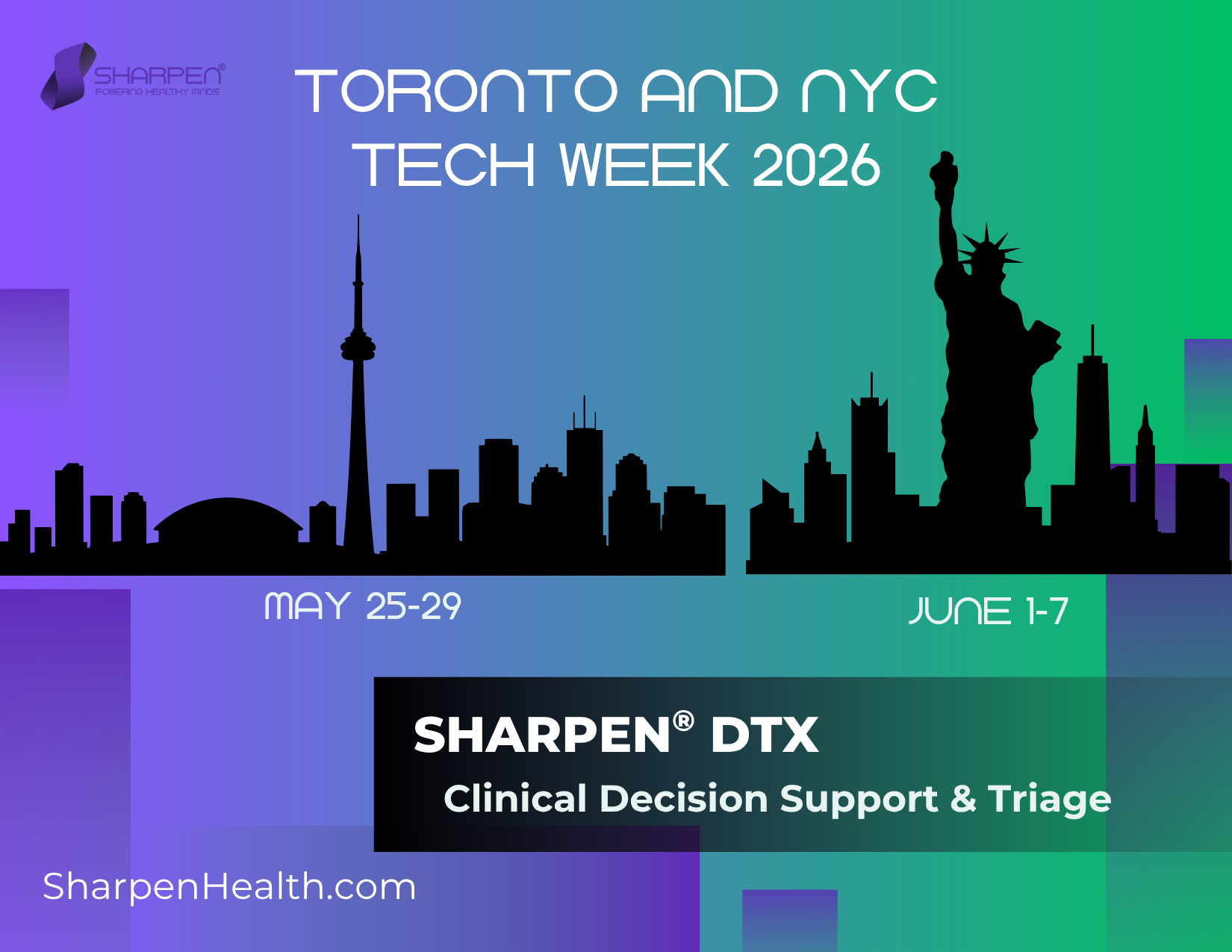
This week, Resiliency Technologies is heading into two of the most consequential technology conversations in North America. First, we head to the Creative Destruction Lab Super Session during Toronto Tech Week, and then to an invitation-only gathering of health and technology leaders during New York Tech Week.
Behavioral Health Has an Infrastructure Problem
The behavioral health crisis is not primarily a shortage of knowledge: we know how to screen for depression, anxiety, trauma, and suicidality, and we know what early intervention looks like.
The problem is the "now what." Clinical infrastructure. As Alicia Bunch, Vice President of Behavioral Health at the University of Colorado Health System, recently put it: "It becomes about the gap analysis — identifying who are the patients that are in need of behavioral health services, what's available, and how do we ensure there's a seamless continuum to connect folks with care." The gap between identifying someone who is struggling and connecting them to the right level of care at the right moment, remains one of the most persistent failures in modern medicine.
Sharpen® DTX was built to close that gap. It delivers evidence-based screening, adaptive clinical triage, and digital therapeutic interventions directly into EHR workflows, delivering real-time patient risk data to clinician dashboards.
The platform is validated across 47,500+ users, 2.85 million module views, and 30+ research studies.
Our AI Engine
At the heart of Sharpen® DTX is a proprietary explainable AI (XAI) algorithm developed since 2023 in partnership with a UC Berkeley data science and computer science team and COMMIT, an AWS Premier-Tier Partner, with funding awarded directly from Amazon Web Services. Sharpen® has now received two competitive AWS grants to advance this work, a distinction that reflects both the rigor of the underlying science and the real-world clinical need the platform addresses.
The algorithm was designed to address one of the most serious and underappreciated problems in health AI. A 2026 umbrella review published in Health Science Reports (PMC) found that many AI systems rely on training datasets that lack demographic diversity, producing biased outputs that reduce effectiveness across varied populations. Sharpen's algorithm was built from the ground-up to counter this. Our model is trained on content drawn from more than 4,000 films featuring the voices of diverse individuals, families, and communities representing the full breadth of the populations Sharpen® serves.
Technically, the engine employs a hybrid machine learning approach that combines collaborative filtering from 25,000+ user interactions with content-based analysis of 4,000+ videos and 700+ evidence-based modules. It builds upon 20 years of longitudinal data to train on sequential learning pathways, parallel protective factor interventions, and optimal timing for clinical activities. In practice, the system integrates real-time user assessment scores and demographic factors to deliver personalized content recommendations Sharpen® is able to dynamically balance user self-selection with clinically-appropriate assigned content.
The architecture integrates Amazon Bedrock for automated content tagging across Sharpen's module library, and Amazon Personalize for behavior-based recommendations. Co-Founder and COO Tim Farrell leads the full AI build project and engineering team, with Founding Engineer, Brian Painter, overseeing platform architecture. Our UC Berkeley engineering team brings cutting-edge ML, NLP, and cloud expertise to a mission they have personally chosen: broadening access to behavioral health care for underserved populations.
Through discussions with FDA Digital Health Center of Excellence, we believe the Sharpen® DTX AI system and clinical platform can advance together through a single regulatory pathway, as well.
Why Tech Week
We look forward to sharing robust outcomes data, a validated platform, a functioning AI engine, and twenty years of evidence with other digital health thought leaders.
As the XAI algorithm matures, it will deepen our capacity to personalize the behavioral health journey for each user, adapting to their clinical risk profile, engagement patterns, and gaps in protection / mental health literacy. For health systems, that means a platform that gets smarter with every deployment. For clinicians, that means better patient outcomes. For patients, it means they can engage in a system that sees them, and understands who they are.
The question we keep coming back to is whether AI can respond to risk at the right moment, for the right person, with evidence-based best practice. We spent twenty years making sure ours was trained on the right data — data that includes diverse, authentic human stories. We are building a clinical judgment layer that gets smarter every time someone uses it. ~Tim Farrell, COO & Co-Founder, Resiliency Technologies
Topics