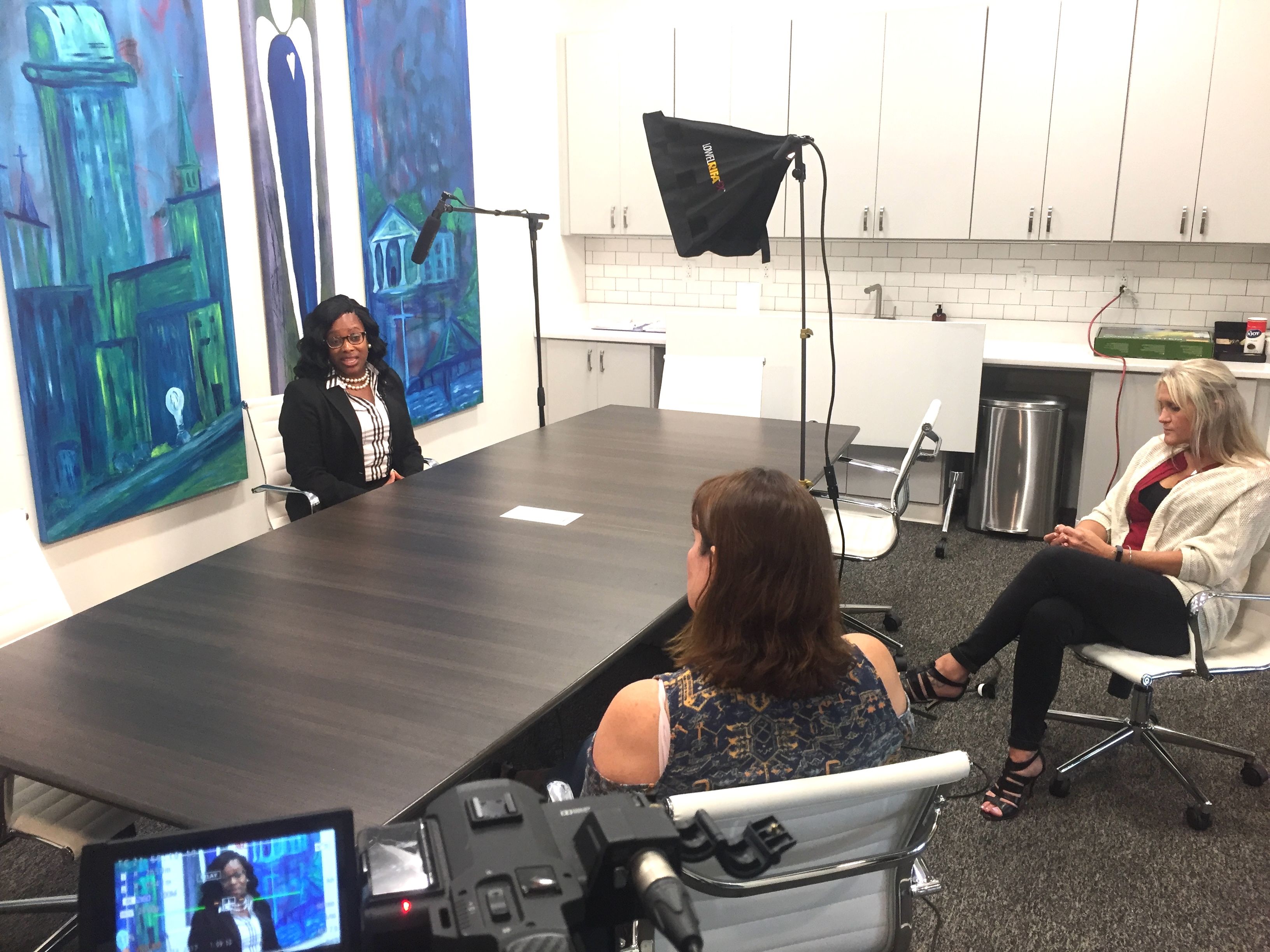
Featured image: Josie Jones, Anderson County Director of Department of Social Services, sits down with Dr. Heather Witt and Robyn Hussa Farrell to share strategies for foster parents.
In 2024, nearly 344,000 children in the United States spent time in foster care (Vandivere, 2026), and up to 80% of children enter care with a significant mental health need (Szilagyi et al., 2015). Yet the homes that care for them are getting harder to find. Between 2021 and 2022, more than half of U.S. states lost licensed foster homes, and South Carolina saw the steepest drop in the country, 61% (Orozco Rodriguez, 2023). Retaining foster parents is as hard as recruiting them: in a three-state study, the median foster parent served just 8 to 14 months (Gibbs & Wildfire, 2007).
The research tells us support for foster parents helps. A 2020 meta-analysis led by Nikita Schoemaker at Leiden University found that interventions for foster and adoptive parents reduced parenting stress and improved parenting skills. A 2019 systematic review by Jannike Kaasbøll and colleagues found that foster parents are generally satisfied with the training they receive, but also that research on that training is scarce, and that foster parents want training that is more advanced, more grounded in real life, and more flexible.
Where we started
South Carolina is where so much of the Sharpen® story began. I spent ten years in the Upstate working alongside District 7 schools and the United Way of the Piedmont to build something impactful for foster parents in collaboration with individuals and organizations specializing in child welfare.
In 2019 or so we began filming dozens of individuals with lived expertise, foster parents, researchers, experts in adverse childhood experiences, and those familiar with the foster care system.
One extremely powerful story was shared by Naomi.
Naomi Lett is the President and CEO of the United Way Association of South Carolina. She shares her powerful story about growing up in foster care in this film.
The films we developed were incorporated into a series of modules specific to recruiting, retaining and supporting foster parents and families. We incorporated those modules into the full library of more than 100 mental health literacy, resiliency and suicide prevention modules and launched the entire toolkit we called Sharpen® Family. The Sharpen® Family toolkit has had more than 124,000 page views, and an average session of more than six minutes, with over 6,600 users from 2019 to the present.
“Just trying to survive every day was completely exhausting, and so to go with a foster family, even though it was temporary, it was like I could rest from all of that… It literally saved my life.”
Extending statewide
In December 2022 through December 2025, I connected with Anna Skipper who, at the time, was leading the foster parent training programming for the SC Foster Parent Association. Anna allowed us to integrate a version of Sharpen® Mental Health Literacy course tailored specifically for them. The training lived inside the SCDSS learning management system and contained evidence-based video modules organized into 16 sections, about five hours in all, counting toward their continuing education requirements.
What we found
In all, 401 foster parents consented to take part in the study, and 334 completed the training along with both the pre- and post-surveys.
Their resilience scores, measured with the Brief Resilience Scale, rose from 3.54 to 3.85. Their self-compassion scores, measured with the Self-Compassion Scale–Short Form, rose from 3.39 to 3.64. Both changes were statistically significant.
When we asked what mattered most, foster parents named three things: practical stress management strategies they could actually use with their kids, reduced stigma around mental health, and a format that fit their lives.
And they stayed with it. Participants averaged 2.07 hours of active time in the training, and average module completion reached 88.5%.
SBM conference
This work has been accepted as a poster at the Society of Behavioral Medicine's 48th Annual Meeting & Scientific Sessions, April 14-17, 2027, in Atlanta.
Our full manuscript is currently under peer review at Children and Youth Services Review, and the preprint is available on SSRN.
I am beyond grateful to Dr. Heather Witt, who led the Sharpen® Family initiative back in 2019. She connected all of the community partners and collaborated with our team to develop these impactful programs. In addition, Dr. Duke Biber at James Madison University is our corresponding author and research partner on so many Sharpen® studies. We are truly grateful to Anna, our partners at SCDSS, and, most of all, to every foster parent who shared expertise, strategic guidance and input so that, as a community, we can all do a better job supporting the children who so deserve hope and healing.
Sources: Biber, D. D., Hussa-Farrell, R., & Farrell, T. Mental health literacy training for foster parents: A three-year implementation and analysis [Preprint]. SSRN. https://papers.ssrn.com/sol3/papers.cfm?abstract_id=6624959
Gibbs, D., & Wildfire, J. (2007). Length of service for foster parents: Using administrative data to understand retention. Children and Youth Services Review, 29(5), 588–599. https://doi.org/10.1016/j.childyouth.2006.11.002
Kaasbøll, J., Lassemo, E., Paulsen, V., Melby, L., & Ose, S. O. (2019). Foster parents' needs, perceptions and satisfaction with foster parent training: A systematic literature review. Children and Youth Services Review, 101, 33–41. https://doi.org/10.1016/j.childyouth.2019.03.041
Orozco Rodriguez, J. (2023, June 14). Foster kids in casino hotels? It happened in rural Nevada amid widespread foster home shortages. KFF Health News. https://kffhealthnews.org/health-industry/rural-foster-home-shortage-nevada-temporary-housing-casino-hotels/
Schoemaker, N. K., Wentholt, W. G. M., Goemans, A., Vermeer, H. J., Juffer, F., & Alink, L. R. A. (2020). A meta-analytic review of parenting interventions in foster care and adoption. Development and Psychopathology. https://doi.org/10.1017/S0954579419000798
Szilagyi, M. A., Rosen, D. S., Rubin, D., Zlotnik, S., Council on Foster Care, Adoption, and Kinship Care, Committee on Adolescence, & Council on Early Childhood. (2015). Health care issues for children and adolescents in foster care and kinship care. Pediatrics, 136(4), e1142–e1166. https://doi.org/10.1542/peds.2015-2655
Vandivere, S. (2026, May 26). 344,000 U.S. children of all ages lived in foster care in 2024. Child Trends. https://www.childtrends.org/publications/344,000-children-all-ages-foster-care-2024
Topics